
Peter Martin
March 10, 2009
THE World Bank has broken a taboo, becoming the first official organisation to predict the global economy will shrink during 2009, to collapse for the first time in more than 60 years.
A previous forecast from the International Monetary Fund predicted global growth of just 0.5 per cent this year, something it described as a recession but "still positive".
The new World Bank assessment, prepared for next week's meeting of finance ministers and treasurers from the world's 20 largest economies, was not specific about the extent of the collapse other than to say that global economic activity would shrink "for the first time since World War II, with growth at least 5 percentage points below potential".
Global industrial production would be down 15 per cent by the middle of this year, with world trade on track to record its largest decline in 80 years.
Of special significance to Australia, the bank said the sharpest falls in trade would occur in East Asia, including Japan and Korea, which between them buy a third of Australia's exports.
Deputy Prime Minister Julia Gillard described the findings as "very disturbing" but refused to be drawn on whether the Government would need to update its forecast that Australia's unemployment rate would peak at 7 per cent.
Official figures to be released on Thursday are likely to show Australia's unemployment rate hitting 5 per cent for the first time since 2006.
An extra 650,000 jobs were lost in the US in February, taking the US unemployment rate past 8 per cent for the first time in 25 years.
This morning's Dun & Bradstreet business expectations survey will indicate that 1 in 4 Australian businesses plans to cut staff, with employment expectations the worst in the survey's history.
Treasurer Wayne Swan, who will attend the London G20 meeting, said the World Bank report underscored the need for a strong economic stimulus program.
An IMF report released on the weekend pressed nations such as Australia to implement additional stimulus measures, saying "given the anticipated weakness in the global economy over the next two years, consideration should be given to providing fiscal stimulus that goes beyond the measures already announced."
"Given the likelihood that the economic weakness will continue into 2010, there should be less concern that the expenditures will only be put into place once the economy has begun to recover," the report said.
IMF staff found the most effective stimulus programs were those involving government investment, while the least effective involved income tax cuts.
Opposition Leader Malcolm Turnbull continued to propose tax cuts on Monday, saying that bringing forward the tax cuts already legislated for July this year and July next would be "like a rising tide, lifting all boats". He also proposed rebating a portion of the superannuation guarantee contribution to small businesses.
The World Bank report warns disruptions caused by the economic crisis are all but certain to overwhelm the ability of institutions like it and the IMF to protect the economies most at risk.
Bank president Robert Zoellick pleaded for wealthy governments to create a "vulnerability fund" and to set aside a fraction of what they spend on stimulating their own economies to help others.
"This global crisis needs a global solution and preventing an economic catastrophe in developing countries is important for global efforts to overcome this crisis," he said.
"We need investments in safety nets, infrastructure, and small and medium-size companies to create jobs and to avoid social and political unrest."
Different day, same news. But worse. Sometimes, I just want to skip through all the bad reports in the papers but I would have reached the end by then. I don't like reading the sports section.
Showing posts with label politics and current affairs. Show all posts
Showing posts with label politics and current affairs. Show all posts
Tuesday, March 10, 2009

Wednesday, January 21, 2009
Obama's inauguration
Dr Martin Luther King quoted by Obama, the 44th U.S. president: "Everybody can be great because anybody can serve"
........
What a fantastic speech. How often do hear world leaders deliver speeches that inspire people (even non-Americans) to live beyond themselves, to embrace traditional values such as diligence and honesty, to hold hope and faith in humanity once again despite the raging storms? I'm once again reminded that our works are also about service to others rather than just ourselves. It's a reminder that's much needed in today's global rat race.
"For as much as government can do and must do, it is ultimately the faith and determination of the American people upon which this nation relies. It is the kindness to take in a stranger when the levees break, the selflessness of workers who would rather cut their hours than see a friend lose their job which sees us through our darkest hours. It is the firefighter's courage to storm a stairway filled with smoke, but also a parent's willingness to nurture a child, that finally decides our fate"
Full transcript (Taken off CNN's website):
My fellow citizens:
I stand here today humbled by the task before us, grateful for the trust you have bestowed, mindful of the sacrifices borne by our ancestors. I thank President Bush for his service to our nation, as well as the generosity and cooperation he has shown throughout this transition.
Forty-four Americans have now taken the presidential oath. The words have been spoken during rising tides of prosperity and the still waters of peace. Yet, every so often, the oath is taken amidst gathering clouds and raging storms. At these moments, America has carried on not simply because of the skill or vision of those in high office, but because We the People have remained faithful to the ideals of our forebearers, and true to our founding documents.
So it has been. So it must be with this generation of Americans.
That we are in the midst of crisis is now well understood. Our nation is at war, against a far-reaching network of violence and hatred. Our economy is badly weakened, a consequence of greed and irresponsibility on the part of some, but also our collective failure to make hard choices and prepare the nation for a new age. Homes have been lost; jobs shed; businesses shuttered. Our health care is too costly; our schools fail too many; and each day brings further evidence that the ways we use energy strengthen our adversaries and threaten our planet.
These are the indicators of crisis, subject to data and statistics. Less measurable but no less profound is a sapping of confidence across our land -- a nagging fear that America's decline is inevitable, and that the next generation must lower its sights.
Don't Miss
* Video coverage of Obama's inauguration
* Monumental expectations for Obama's address
Today I say to you that the challenges we face are real. They are serious and they are many. They will not be met easily or in a short span of time. But know this, America: They will be met.
On this day, we gather because we have chosen hope over fear, unity of purpose over conflict and discord.
On this day, we come to proclaim an end to the petty grievances and false promises, the recriminations and worn-out dogmas, that for far too long have strangled our politics.
We remain a young nation, but in the words of Scripture, the time has come to set aside childish things. The time has come to reaffirm our enduring spirit; to choose our better history; to carry forward that precious gift, that noble idea, passed on from generation to generation: the God-given promise that all are equal, all are free, and all deserve a chance to pursue their full measure of happiness.
In reaffirming the greatness of our nation, we understand that greatness is never a given. It must be earned. Our journey has never been one of shortcuts or settling for less. It has not been the path for the fainthearted -- for those who prefer leisure over work, or seek only the pleasures of riches and fame. Rather, it has been the risk-takers, the doers, the makers of things -- some celebrated, but more often men and women obscure in their labor -- who have carried us up the long, rugged path toward prosperity and freedom.
For us, they packed up their few worldly possessions and traveled across oceans in search of a new life.
For us, they toiled in sweatshops and settled the West; endured the lash of the whip and plowed the hard earth.
For us, they fought and died, in places like Concord and Gettysburg; Normandy and Khe Sahn.
Time and again, these men and women struggled and sacrificed and worked till their hands were raw so that we might live a better life. They saw America as bigger than the sum of our individual ambitions; greater than all the differences of birth or wealth or faction.
This is the journey we continue today. We remain the most prosperous, powerful nation on Earth. Our workers are no less productive than when this crisis began. Our minds are no less inventive, our goods and services no less needed than they were last week or last month or last year. Our capacity remains undiminished. But our time of standing pat, of protecting narrow interests and putting off unpleasant decisions -- that time has surely passed. Starting today, we must pick ourselves up, dust ourselves off, and begin again the work of remaking America.
For everywhere we look, there is work to be done. The state of the economy calls for action, bold and swift, and we will act -- not only to create new jobs, but to lay a new foundation for growth. We will build the roads and bridges, the electric grids and digital lines that feed our commerce and bind us together. We will restore science to its rightful place, and wield technology's wonders to raise health care's quality and lower its cost. We will harness the sun and the winds and the soil to fuel our cars and run our factories. And we will transform our schools and colleges and universities to meet the demands of a new age. All this we can do. And all this we will do.
Now, there are some who question the scale of our ambitions -- who suggest that our system cannot tolerate too many big plans. Their memories are short. For they have forgotten what this country has already done; what free men and women can achieve when imagination is joined to common purpose, and necessity to courage.
What the cynics fail to understand is that the ground has shifted beneath them -- that the stale political arguments that have consumed us for so long no longer apply. The question we ask today is not whether our government is too big or too small, but whether it works -- whether it helps families find jobs at a decent wage, care they can afford, a retirement that is dignified. Where the answer is yes, we intend to move forward. Where the answer is no, programs will end. And those of us who manage the public's dollars will be held to account -- to spend wisely, reform bad habits, and do our business in the light of day -- because only then can we restore the vital trust between a people and their government.
Nor is the question before us whether the market is a force for good or ill. Its power to generate wealth and expand freedom is unmatched, but this crisis has reminded us that without a watchful eye, the market can spin out of control -- and that a nation cannot prosper long when it favors only the prosperous. The success of our economy has always depended not just on the size of our gross domestic product, but on the reach of our prosperity; on our ability to extend opportunity to every willing heart -- not out of charity, but because it is the surest route to our common good.
As for our common defense, we reject as false the choice between our safety and our ideals. Our Founding Fathers, faced with perils we can scarcely imagine, drafted a charter to assure the rule of law and the rights of man, a charter expanded by the blood of generations. Those ideals still light the world, and we will not give them up for expedience's sake. And so to all other peoples and governments who are watching today, from the grandest capitals to the small village where my father was born: Know that America is a friend of each nation and every man, woman and child who seeks a future of peace and dignity, and that we are ready to lead once more.
Recall that earlier generations faced down fascism and communism not just with missiles and tanks, but with sturdy alliances and enduring convictions. They understood that our power alone cannot protect us, nor does it entitle us to do as we please. Instead, they knew that our power grows through its prudent use; our security emanates from the justness of our cause, the force of our example, the tempering qualities of humility and restraint.
We are the keepers of this legacy. Guided by these principles once more, we can meet those new threats that demand even greater effort -- even greater cooperation and understanding between nations. We will begin to responsibly leave Iraq to its people, and forge a hard-earned peace in Afghanistan. With old friends and former foes, we will work tirelessly to lessen the nuclear threat, and roll back the specter of a warming planet. We will not apologize for our way of life, nor will we waver in its defense, and for those who seek to advance their aims by inducing terror and slaughtering innocents, we say to you now that our spirit is stronger and cannot be broken; you cannot outlast us, and we will defeat you.
For we know that our patchwork heritage is a strength, not a weakness. We are a nation of Christians and Muslims, Jews and Hindus -- and nonbelievers. We are shaped by every language and culture, drawn from every end of this Earth; and because we have tasted the bitter swill of civil war and segregation, and emerged from that dark chapter stronger and more united, we cannot help but believe that the old hatreds shall someday pass; that the lines of tribe shall soon dissolve; that as the world grows smaller, our common humanity shall reveal itself; and that America must play its role in ushering in a new era of peace.
To the Muslim world, we seek a new way forward, based on mutual interest and mutual respect. To those leaders around the globe who seek to sow conflict, or blame their society's ills on the West: Know that your people will judge you on what you can build, not what you destroy. To those who cling to power through corruption and deceit and the silencing of dissent, know that you are on the wrong side of history; but that we will extend a hand if you are willing to unclench your fist.
To the people of poor nations, we pledge to work alongside you to make your farms flourish and let clean waters flow; to nourish starved bodies and feed hungry minds. And to those nations like ours that enjoy relative plenty, we say we can no longer afford indifference to suffering outside our borders; nor can we consume the world's resources without regard to effect. For the world has changed, and we must change with it.
As we consider the road that unfolds before us, we remember with humble gratitude those brave Americans who, at this very hour, patrol far-off deserts and distant mountains. They have something to tell us today, just as the fallen heroes who lie in Arlington whisper through the ages. We honor them not only because they are guardians of our liberty, but because they embody the spirit of service; a willingness to find meaning in something greater than themselves. And yet, at this moment -- a moment that will define a generation -- it is precisely this spirit that must inhabit us all.
For as much as government can do and must do, it is ultimately the faith and determination of the American people upon which this nation relies. It is the kindness to take in a stranger when the levees break, the selflessness of workers who would rather cut their hours than see a friend lose their job which sees us through our darkest hours. It is the firefighter's courage to storm a stairway filled with smoke, but also a parent's willingness to nurture a child, that finally decides our fate.
Our challenges may be new. The instruments with which we meet them may be new. But those values upon which our success depends -- hard work and honesty, courage and fair play, tolerance and curiosity, loyalty and patriotism -- these things are old. These things are true. They have been the quiet force of progress throughout our history. What is demanded then is a return to these truths. What is required of us now is a new era of responsibility -- a recognition, on the part of every American, that we have duties to ourselves, our nation and the world; duties that we do not grudgingly accept but rather seize gladly, firm in the knowledge that there is nothing so satisfying to the spirit, so defining of our character, than giving our all to a difficult task.
This is the price and the promise of citizenship.
This is the source of our confidence -- the knowledge that God calls on us to shape an uncertain destiny.
This is the meaning of our liberty and our creed -- why men and women and children of every race and every faith can join in celebration across this magnificent Mall, and why a man whose father less than 60 years ago might not have been served at a local restaurant can now stand before you to take a most sacred oath.
So let us mark this day with remembrance, of who we are and how far we have traveled. In the year of America's birth, in the coldest of months, a small band of patriots huddled by dying campfires on the shores of an icy river. The capital was abandoned. The enemy was advancing. The snow was stained with blood. At a moment when the outcome of our revolution was most in doubt, the father of our nation ordered these words be read to the people:
"Let it be told to the future world ... that in the depth of winter, when nothing but hope and virtue could survive... that the city and the country, alarmed at one common danger, came forth to meet [it]."
America. In the face of our common dangers, in this winter of our hardship, let us remember these timeless words. With hope and virtue, let us brave once more the icy currents, and endure what storms may come. Let it be said by our children's children that when we were tested, we refused to let this journey end, that we did not turn back, nor did we falter; and with eyes fixed on the horizon and God's grace upon us, we carried forth that great gift of freedom and delivered it safely to future generations
On a different note, here's what the most powerful man in the world looks like:
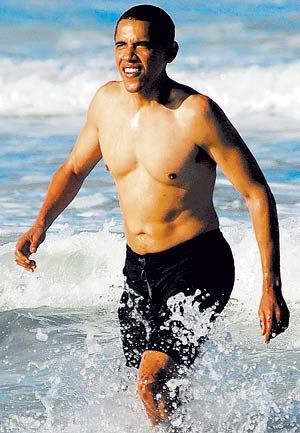
Check out his six packs! Good looking, intelligent, articulate, fit, tall, U.S. president. Tell me, what does he lack?
........
What a fantastic speech. How often do hear world leaders deliver speeches that inspire people (even non-Americans) to live beyond themselves, to embrace traditional values such as diligence and honesty, to hold hope and faith in humanity once again despite the raging storms? I'm once again reminded that our works are also about service to others rather than just ourselves. It's a reminder that's much needed in today's global rat race.
"For as much as government can do and must do, it is ultimately the faith and determination of the American people upon which this nation relies. It is the kindness to take in a stranger when the levees break, the selflessness of workers who would rather cut their hours than see a friend lose their job which sees us through our darkest hours. It is the firefighter's courage to storm a stairway filled with smoke, but also a parent's willingness to nurture a child, that finally decides our fate"
Full transcript (Taken off CNN's website):
My fellow citizens:
I stand here today humbled by the task before us, grateful for the trust you have bestowed, mindful of the sacrifices borne by our ancestors. I thank President Bush for his service to our nation, as well as the generosity and cooperation he has shown throughout this transition.
Forty-four Americans have now taken the presidential oath. The words have been spoken during rising tides of prosperity and the still waters of peace. Yet, every so often, the oath is taken amidst gathering clouds and raging storms. At these moments, America has carried on not simply because of the skill or vision of those in high office, but because We the People have remained faithful to the ideals of our forebearers, and true to our founding documents.
So it has been. So it must be with this generation of Americans.
That we are in the midst of crisis is now well understood. Our nation is at war, against a far-reaching network of violence and hatred. Our economy is badly weakened, a consequence of greed and irresponsibility on the part of some, but also our collective failure to make hard choices and prepare the nation for a new age. Homes have been lost; jobs shed; businesses shuttered. Our health care is too costly; our schools fail too many; and each day brings further evidence that the ways we use energy strengthen our adversaries and threaten our planet.
These are the indicators of crisis, subject to data and statistics. Less measurable but no less profound is a sapping of confidence across our land -- a nagging fear that America's decline is inevitable, and that the next generation must lower its sights.
Don't Miss
* Video coverage of Obama's inauguration
* Monumental expectations for Obama's address
Today I say to you that the challenges we face are real. They are serious and they are many. They will not be met easily or in a short span of time. But know this, America: They will be met.
On this day, we gather because we have chosen hope over fear, unity of purpose over conflict and discord.
On this day, we come to proclaim an end to the petty grievances and false promises, the recriminations and worn-out dogmas, that for far too long have strangled our politics.
We remain a young nation, but in the words of Scripture, the time has come to set aside childish things. The time has come to reaffirm our enduring spirit; to choose our better history; to carry forward that precious gift, that noble idea, passed on from generation to generation: the God-given promise that all are equal, all are free, and all deserve a chance to pursue their full measure of happiness.
In reaffirming the greatness of our nation, we understand that greatness is never a given. It must be earned. Our journey has never been one of shortcuts or settling for less. It has not been the path for the fainthearted -- for those who prefer leisure over work, or seek only the pleasures of riches and fame. Rather, it has been the risk-takers, the doers, the makers of things -- some celebrated, but more often men and women obscure in their labor -- who have carried us up the long, rugged path toward prosperity and freedom.
For us, they packed up their few worldly possessions and traveled across oceans in search of a new life.
For us, they toiled in sweatshops and settled the West; endured the lash of the whip and plowed the hard earth.
For us, they fought and died, in places like Concord and Gettysburg; Normandy and Khe Sahn.
Time and again, these men and women struggled and sacrificed and worked till their hands were raw so that we might live a better life. They saw America as bigger than the sum of our individual ambitions; greater than all the differences of birth or wealth or faction.
This is the journey we continue today. We remain the most prosperous, powerful nation on Earth. Our workers are no less productive than when this crisis began. Our minds are no less inventive, our goods and services no less needed than they were last week or last month or last year. Our capacity remains undiminished. But our time of standing pat, of protecting narrow interests and putting off unpleasant decisions -- that time has surely passed. Starting today, we must pick ourselves up, dust ourselves off, and begin again the work of remaking America.
For everywhere we look, there is work to be done. The state of the economy calls for action, bold and swift, and we will act -- not only to create new jobs, but to lay a new foundation for growth. We will build the roads and bridges, the electric grids and digital lines that feed our commerce and bind us together. We will restore science to its rightful place, and wield technology's wonders to raise health care's quality and lower its cost. We will harness the sun and the winds and the soil to fuel our cars and run our factories. And we will transform our schools and colleges and universities to meet the demands of a new age. All this we can do. And all this we will do.
Now, there are some who question the scale of our ambitions -- who suggest that our system cannot tolerate too many big plans. Their memories are short. For they have forgotten what this country has already done; what free men and women can achieve when imagination is joined to common purpose, and necessity to courage.
What the cynics fail to understand is that the ground has shifted beneath them -- that the stale political arguments that have consumed us for so long no longer apply. The question we ask today is not whether our government is too big or too small, but whether it works -- whether it helps families find jobs at a decent wage, care they can afford, a retirement that is dignified. Where the answer is yes, we intend to move forward. Where the answer is no, programs will end. And those of us who manage the public's dollars will be held to account -- to spend wisely, reform bad habits, and do our business in the light of day -- because only then can we restore the vital trust between a people and their government.
Nor is the question before us whether the market is a force for good or ill. Its power to generate wealth and expand freedom is unmatched, but this crisis has reminded us that without a watchful eye, the market can spin out of control -- and that a nation cannot prosper long when it favors only the prosperous. The success of our economy has always depended not just on the size of our gross domestic product, but on the reach of our prosperity; on our ability to extend opportunity to every willing heart -- not out of charity, but because it is the surest route to our common good.
As for our common defense, we reject as false the choice between our safety and our ideals. Our Founding Fathers, faced with perils we can scarcely imagine, drafted a charter to assure the rule of law and the rights of man, a charter expanded by the blood of generations. Those ideals still light the world, and we will not give them up for expedience's sake. And so to all other peoples and governments who are watching today, from the grandest capitals to the small village where my father was born: Know that America is a friend of each nation and every man, woman and child who seeks a future of peace and dignity, and that we are ready to lead once more.
Recall that earlier generations faced down fascism and communism not just with missiles and tanks, but with sturdy alliances and enduring convictions. They understood that our power alone cannot protect us, nor does it entitle us to do as we please. Instead, they knew that our power grows through its prudent use; our security emanates from the justness of our cause, the force of our example, the tempering qualities of humility and restraint.
We are the keepers of this legacy. Guided by these principles once more, we can meet those new threats that demand even greater effort -- even greater cooperation and understanding between nations. We will begin to responsibly leave Iraq to its people, and forge a hard-earned peace in Afghanistan. With old friends and former foes, we will work tirelessly to lessen the nuclear threat, and roll back the specter of a warming planet. We will not apologize for our way of life, nor will we waver in its defense, and for those who seek to advance their aims by inducing terror and slaughtering innocents, we say to you now that our spirit is stronger and cannot be broken; you cannot outlast us, and we will defeat you.
For we know that our patchwork heritage is a strength, not a weakness. We are a nation of Christians and Muslims, Jews and Hindus -- and nonbelievers. We are shaped by every language and culture, drawn from every end of this Earth; and because we have tasted the bitter swill of civil war and segregation, and emerged from that dark chapter stronger and more united, we cannot help but believe that the old hatreds shall someday pass; that the lines of tribe shall soon dissolve; that as the world grows smaller, our common humanity shall reveal itself; and that America must play its role in ushering in a new era of peace.
To the Muslim world, we seek a new way forward, based on mutual interest and mutual respect. To those leaders around the globe who seek to sow conflict, or blame their society's ills on the West: Know that your people will judge you on what you can build, not what you destroy. To those who cling to power through corruption and deceit and the silencing of dissent, know that you are on the wrong side of history; but that we will extend a hand if you are willing to unclench your fist.
To the people of poor nations, we pledge to work alongside you to make your farms flourish and let clean waters flow; to nourish starved bodies and feed hungry minds. And to those nations like ours that enjoy relative plenty, we say we can no longer afford indifference to suffering outside our borders; nor can we consume the world's resources without regard to effect. For the world has changed, and we must change with it.
As we consider the road that unfolds before us, we remember with humble gratitude those brave Americans who, at this very hour, patrol far-off deserts and distant mountains. They have something to tell us today, just as the fallen heroes who lie in Arlington whisper through the ages. We honor them not only because they are guardians of our liberty, but because they embody the spirit of service; a willingness to find meaning in something greater than themselves. And yet, at this moment -- a moment that will define a generation -- it is precisely this spirit that must inhabit us all.
For as much as government can do and must do, it is ultimately the faith and determination of the American people upon which this nation relies. It is the kindness to take in a stranger when the levees break, the selflessness of workers who would rather cut their hours than see a friend lose their job which sees us through our darkest hours. It is the firefighter's courage to storm a stairway filled with smoke, but also a parent's willingness to nurture a child, that finally decides our fate.
Our challenges may be new. The instruments with which we meet them may be new. But those values upon which our success depends -- hard work and honesty, courage and fair play, tolerance and curiosity, loyalty and patriotism -- these things are old. These things are true. They have been the quiet force of progress throughout our history. What is demanded then is a return to these truths. What is required of us now is a new era of responsibility -- a recognition, on the part of every American, that we have duties to ourselves, our nation and the world; duties that we do not grudgingly accept but rather seize gladly, firm in the knowledge that there is nothing so satisfying to the spirit, so defining of our character, than giving our all to a difficult task.
This is the price and the promise of citizenship.
This is the source of our confidence -- the knowledge that God calls on us to shape an uncertain destiny.
This is the meaning of our liberty and our creed -- why men and women and children of every race and every faith can join in celebration across this magnificent Mall, and why a man whose father less than 60 years ago might not have been served at a local restaurant can now stand before you to take a most sacred oath.
So let us mark this day with remembrance, of who we are and how far we have traveled. In the year of America's birth, in the coldest of months, a small band of patriots huddled by dying campfires on the shores of an icy river. The capital was abandoned. The enemy was advancing. The snow was stained with blood. At a moment when the outcome of our revolution was most in doubt, the father of our nation ordered these words be read to the people:
"Let it be told to the future world ... that in the depth of winter, when nothing but hope and virtue could survive... that the city and the country, alarmed at one common danger, came forth to meet [it]."
America. In the face of our common dangers, in this winter of our hardship, let us remember these timeless words. With hope and virtue, let us brave once more the icy currents, and endure what storms may come. Let it be said by our children's children that when we were tested, we refused to let this journey end, that we did not turn back, nor did we falter; and with eyes fixed on the horizon and God's grace upon us, we carried forth that great gift of freedom and delivered it safely to future generations
On a different note, here's what the most powerful man in the world looks like:

Check out his six packs! Good looking, intelligent, articulate, fit, tall, U.S. president. Tell me, what does he lack?
Friday, November 07, 2008
Pointing fingers - Alan Greenspan to be blamed for the economic crisis?
I blogged about Alan Greenspan in January 2006, just before he left office as Chairman of the US Federal Reserve. In that entry, I wrote about him based on an article I read in the Economist. Although he has been acclaimed by many economists as 'the greatest central banker who ever lived', some critics had their reservations on him. Here's my entry that I wrote almost 3 years ago:
Ahead of his retirement, he has been widely and extravagantly acclaimed by economic commentators, investors and politicians. He has been honoured and left a legend with a well-rehearsed quote to his name, 'The greatest central banker who ever lived.'
To refresh our memories, here is a snippet of Alan Greenspan background :-
He originally took office as Chairman and to fill an unexpired term as a member of the Board on August 11, 1987. Dr. Greenspan was reappointed to the Board to a full 14-year term, which began February 1, 1992, and ends January 31, 2006. He has been designated Chairman by Presidents Reagan, Bush, Clinton, and Bush.
Dr. Greenspan was born on March 6, 1926, in New York City. He received a B.S. in economics (summa cum laude) in 1948, an M.A. in economics in 1950, and a Ph.D. in economics in 1977, all from New York University. Dr. Greenspan also has performed advanced graduate study at Columbia University.
From 1954 to 1974 and from 1977 to 1987, Dr. Greenspan was Chairman and President of Townsend-Greenspan & Co., Inc., an economic consulting firm in New York City. From 1974 to 1977, he served as Chairman of the President's Council of Economic Advisers under President Ford, and from 1981 to 1983, as Chairman of the National Commission on Social Security Reform.
Dr. Greenspan has also served as a member of President Reagan's Economic Policy Advisory Board, a member of Time magazine's Board of Economists, a senior adviser to the Brookings Panel on Economic Activity, and a consultant to the Congressional Budget Office.
His previous Presidential appointments include the President's Foreign Intelligence Advisory Board, the Commission on Financial Structure and Regulation, the Commission on an All-Volunteer Armed Force, and the Task Force on Economic Growth.
Before his appointment to the Board, Dr. Greenspan served as a corporate director for Aluminum Company of America (Alcoa); Automatic Data Processing, Inc.; Capital Cities/ABC, Inc.; General Foods, Inc.; J.P. Morgan & Co., Inc.; Morgan Guaranty Trust Company of New York; Mobil Corporation; and The Pittston Company.
His noncorporate positions have included Member of the Board of Trustees, The Rand Corporation; Director, Institute for International Economics; Member of the Board of Overseers, Hoover Institution (at Stanford University); and Vice Chairman and Trustee, Economic Club of New York.
Dr. Greenspan has served as Chairman of the Conference of Business Economists, President and Fellow of the National Association of Business Economists, and Director of the National Economists Club.
Dr. Greenspan has received honorary degrees from Harvard, Yale, Pennsylvania, Leuven (Belgium), Notre Dame, Wake Forest, Colgate, and Edinburgh universities. His other awards include the Thomas Jefferson Award for the greatest public service performed by an elected or appointed official, presented by the American Institute for Public Service, 1976 (joint recipient with Dr. Arthur Burns and William Simon); election as a Fellow of the American Statistical Association, 1989; decorated Legion of Honor (Commander) France, 2000; recipient of the American Philosophical Society’s Benjamin Franklin Award for Distinguished Public Service, 1998, and election as a member of the society, 2000; honorary Knight Commander of the British Empire, 2002; and the first recipient of the Gerald R. Ford Medal for Distinguished Public Service, 2003.
On the surface of things, one could presume that Alan Greenspan struck up a miracle in favour of America's fate during his 18 1/2 years in office. During most of his service in office, America enjoy rapid growth with low inflation. In addition, he successfully steered the economy around a series of financial hazards. He is credited with saving the world economy—from the stockmarket crashes of 1987 and 2000-01, and from Russia's default and the near collapse of LTCM, a hedge fund, in 1998—by pumping in liquidity when it was vulnerable.
Many have predict that the reign of America's economy has reached its peek and gloomy days now await. Gloomy days will not be caused by Greenspan's departure but by his departuring souvenirs: the biggest economic imbalances in America.
Commentators are now debating if the works of Alan Greenspan is worth its current glory or did he instead leave a time-bomb in America's hands?
America's market demand significantly outweighs and outraces market supply. The Federal Reserve's policies of the past decade looks like its having painful long-term costs. We should not forget that Mr Greenspan was long criticised by economic commentator's for not trying to restrain the stockmarket bubble in the late 1990s. And after its burst, Alan Greenspan, inflated a housing bubble by holding low interest rates for so long. By borrowing against capital gains, households consume more than their monthly income. Although robust consumer spending has boosted GDP growth, this is a short-term benefit at a huge cost of a negative personal saving rate.
In all this seriousness, Ben Bernanke, Mr Greenspan's successor had to cheek to say that America's current-account deficit is the inevitable consequence of a saving glut in the rest of the world.
............
It seems that those critics rightly disagreed with Alan Greenspan. Although everything seemed smooth sailing during the time he was in office, he left a time bomb that was only waiting to explode. Tragically, no one including Greenspan himself expected the time bomb he helped create to be this destructive.
............
Read this recent article by Seattle Times
WASHINGTON — As Federal Reserve chairman, Alan Greenspan testified before Congress dozens of times over almost two decades.
Time after time, lawmakers solicited the economic wisdom of "the Oracle."
But not Thursday.
This time, instead of praise, lawmakers heaped blame on the 82-year-old economist for the current crisis and asked him time and again whether he had been wrong, why he had been wrong and whether he was sorry.
Grim-faced, Greenspan could offer only a limited defense.
Almost three years after stepping down as the Fed chair, a humbled Greenspan admitted he had put too much faith in the self-correcting power of free markets and had failed to foresee the self-destructive power of wanton mortgage lending.
In his trademark gravelly monotone, he acknowledged he was in a state of "shocked disbelief" at the breakdown of credit markets that triggered what he called "a once-in-a-century credit tsunami."
"This crisis ... has turned out to be much broader than anything I could have imagined," he told the House Oversight and Government Reform Committee. "Given the financial damage to date, I cannot see how we can avoid a significant rise in layoffs and unemployment."
The appearance was his first in such a public forum since the crisis began and provided a dramatic bookend for the demise of the economic boom and the unmaking of his reputation.
Critics, including many economists, now blame the former Fed chairman for the financial crisis that is tipping the economy into a potentially deep recession. Greenspan's critics say he encouraged the bubble in housing prices by keeping interest rates too low for too long and he failed to rein in the explosive growth of risky and often fraudulent mortgage lending.
Near the end of the four-hour grilling, which he shared with John Snow, the former Treasury secretary, and Christopher Cox, chairman of the Securities and Exchange Commission, Greenspan suffered a final indignity.
The man dubbed "the Maestro" for orchestrating fiscal policy during 18 years as Fed chief found himself likened to one of the great goats of baseball.
"I feel like I'm looking out there at three Bill Buckners," said Rep. John Yarmuth, D-Ky., referring to the Boston Red Sox first baseman who botched an easy grounder in the 1986 World Series. "All of you let the ball go through your legs."
Snow and Cox took a lot of criticism as well. But it was unprecedented to see Greenspan booed for a crucial error.
Under tough questioning from committee Chairman Henry Waxman, D-Calif., and other Democrats, Greenspan said he was wrong in assuming free-market forces would prevent the current crisis.
"I made a mistake in presuming that the self-interests of organizations, specifically banks and others, were such as that they were best capable of protecting their own shareholders and their equity in the firms," Greenspan said.
The crisis exposed a "flaw" in his strong market-based ideology, he said.
"That's precisely the reason I was shocked, because I have been going for 40 years or more with very considerable evidence that it was working exceptionally well," Greenspan said.
The hearing was the third in a series Waxman is holding to identify the causes of the financial crisis. Greenspan knew he was in for a tough day. And Waxman hit him at the start.
"For too long, the prevailing attitude in Washington has been that the market always knows best," Waxman said. "The Federal Reserve had the authority to stop the irresponsible lending practices that fueled the subprime mortgage market. But its longtime chairman, Alan Greenspan, rejected pleas that he intervene."
Greenspan's critics have complained that, starting in 2001, he kept interest rates too low to help bolster the U.S. economy after the bursting of the dot-com bubble and the terrorist attacks of Sept. 11 that year. That easy credit, they say, fueled a runaway housing boom.
They also allege his free-market ideology kept him from using Federal Reserve authority to regulate adjustable-rate mortgages and complex financial derivatives — regulation that could have helped prevent the current crisis.
Waxman, noting the former Fed chairman had been one of the nation's leading voices for deregulation, displayed past statements in which Greenspan had argued that government regulators were no better than markets at imposing discipline.
"Were you wrong?" Waxman asked.
"Partially," the former Fed chairman reluctantly answered, before trying to parse his concession as thinly as possible.
Greenspan, celebrated in a 2000 book by Bob Woodward, presided over the Fed for 18 years before he stepped down in January 2006. He steered the economy through one of the longest booms in history, while also presiding over a period of declining inflation.
But as the Fed slashed interest rates to nearly all-time lows from 2001 until mid-2004, housing prices climbed far faster than inflation or household income year after year. By 2004, a growing number of economists were warning that a speculative bubble in home prices and home construction was under way, which posed the risk of a housing bust.
Greenspan brushed aside worries about a potential bubble, arguing housing prices had never endured a nationwide decline and a bust was highly unlikely.
Greenspan, along with most other banking regulators in Washington, also resisted calls for tighter regulation of subprime mortgages and other high-risk exotic mortgages that allowed people to borrow far more than they could afford.
The Federal Reserve had broad authority to prohibit deceptive lending practices under a 1994 law called the Home Owner Equity Protection Act, or HOEPA. But it took little action during the long housing boom, and less than 1 percent of all mortgages were subjected to restrictions under that law.
This year, the Fed dramatically tightened its restrictions. But by that time, the subprime market, as well as the market for other kinds of exotic mortgages, already had been wiped out.
Ahead of his retirement, he has been widely and extravagantly acclaimed by economic commentators, investors and politicians. He has been honoured and left a legend with a well-rehearsed quote to his name, 'The greatest central banker who ever lived.'
To refresh our memories, here is a snippet of Alan Greenspan background :-
He originally took office as Chairman and to fill an unexpired term as a member of the Board on August 11, 1987. Dr. Greenspan was reappointed to the Board to a full 14-year term, which began February 1, 1992, and ends January 31, 2006. He has been designated Chairman by Presidents Reagan, Bush, Clinton, and Bush.
Dr. Greenspan was born on March 6, 1926, in New York City. He received a B.S. in economics (summa cum laude) in 1948, an M.A. in economics in 1950, and a Ph.D. in economics in 1977, all from New York University. Dr. Greenspan also has performed advanced graduate study at Columbia University.
From 1954 to 1974 and from 1977 to 1987, Dr. Greenspan was Chairman and President of Townsend-Greenspan & Co., Inc., an economic consulting firm in New York City. From 1974 to 1977, he served as Chairman of the President's Council of Economic Advisers under President Ford, and from 1981 to 1983, as Chairman of the National Commission on Social Security Reform.
Dr. Greenspan has also served as a member of President Reagan's Economic Policy Advisory Board, a member of Time magazine's Board of Economists, a senior adviser to the Brookings Panel on Economic Activity, and a consultant to the Congressional Budget Office.
His previous Presidential appointments include the President's Foreign Intelligence Advisory Board, the Commission on Financial Structure and Regulation, the Commission on an All-Volunteer Armed Force, and the Task Force on Economic Growth.
Before his appointment to the Board, Dr. Greenspan served as a corporate director for Aluminum Company of America (Alcoa); Automatic Data Processing, Inc.; Capital Cities/ABC, Inc.; General Foods, Inc.; J.P. Morgan & Co., Inc.; Morgan Guaranty Trust Company of New York; Mobil Corporation; and The Pittston Company.
His noncorporate positions have included Member of the Board of Trustees, The Rand Corporation; Director, Institute for International Economics; Member of the Board of Overseers, Hoover Institution (at Stanford University); and Vice Chairman and Trustee, Economic Club of New York.
Dr. Greenspan has served as Chairman of the Conference of Business Economists, President and Fellow of the National Association of Business Economists, and Director of the National Economists Club.
Dr. Greenspan has received honorary degrees from Harvard, Yale, Pennsylvania, Leuven (Belgium), Notre Dame, Wake Forest, Colgate, and Edinburgh universities. His other awards include the Thomas Jefferson Award for the greatest public service performed by an elected or appointed official, presented by the American Institute for Public Service, 1976 (joint recipient with Dr. Arthur Burns and William Simon); election as a Fellow of the American Statistical Association, 1989; decorated Legion of Honor (Commander) France, 2000; recipient of the American Philosophical Society’s Benjamin Franklin Award for Distinguished Public Service, 1998, and election as a member of the society, 2000; honorary Knight Commander of the British Empire, 2002; and the first recipient of the Gerald R. Ford Medal for Distinguished Public Service, 2003.
On the surface of things, one could presume that Alan Greenspan struck up a miracle in favour of America's fate during his 18 1/2 years in office. During most of his service in office, America enjoy rapid growth with low inflation. In addition, he successfully steered the economy around a series of financial hazards. He is credited with saving the world economy—from the stockmarket crashes of 1987 and 2000-01, and from Russia's default and the near collapse of LTCM, a hedge fund, in 1998—by pumping in liquidity when it was vulnerable.
Many have predict that the reign of America's economy has reached its peek and gloomy days now await. Gloomy days will not be caused by Greenspan's departure but by his departuring souvenirs: the biggest economic imbalances in America.
Commentators are now debating if the works of Alan Greenspan is worth its current glory or did he instead leave a time-bomb in America's hands?
America's market demand significantly outweighs and outraces market supply. The Federal Reserve's policies of the past decade looks like its having painful long-term costs. We should not forget that Mr Greenspan was long criticised by economic commentator's for not trying to restrain the stockmarket bubble in the late 1990s. And after its burst, Alan Greenspan, inflated a housing bubble by holding low interest rates for so long. By borrowing against capital gains, households consume more than their monthly income. Although robust consumer spending has boosted GDP growth, this is a short-term benefit at a huge cost of a negative personal saving rate.
In all this seriousness, Ben Bernanke, Mr Greenspan's successor had to cheek to say that America's current-account deficit is the inevitable consequence of a saving glut in the rest of the world.
............
It seems that those critics rightly disagreed with Alan Greenspan. Although everything seemed smooth sailing during the time he was in office, he left a time bomb that was only waiting to explode. Tragically, no one including Greenspan himself expected the time bomb he helped create to be this destructive.
............
Read this recent article by Seattle Times
WASHINGTON — As Federal Reserve chairman, Alan Greenspan testified before Congress dozens of times over almost two decades.
Time after time, lawmakers solicited the economic wisdom of "the Oracle."
But not Thursday.
This time, instead of praise, lawmakers heaped blame on the 82-year-old economist for the current crisis and asked him time and again whether he had been wrong, why he had been wrong and whether he was sorry.
Grim-faced, Greenspan could offer only a limited defense.
Almost three years after stepping down as the Fed chair, a humbled Greenspan admitted he had put too much faith in the self-correcting power of free markets and had failed to foresee the self-destructive power of wanton mortgage lending.
In his trademark gravelly monotone, he acknowledged he was in a state of "shocked disbelief" at the breakdown of credit markets that triggered what he called "a once-in-a-century credit tsunami."
"This crisis ... has turned out to be much broader than anything I could have imagined," he told the House Oversight and Government Reform Committee. "Given the financial damage to date, I cannot see how we can avoid a significant rise in layoffs and unemployment."
The appearance was his first in such a public forum since the crisis began and provided a dramatic bookend for the demise of the economic boom and the unmaking of his reputation.
Critics, including many economists, now blame the former Fed chairman for the financial crisis that is tipping the economy into a potentially deep recession. Greenspan's critics say he encouraged the bubble in housing prices by keeping interest rates too low for too long and he failed to rein in the explosive growth of risky and often fraudulent mortgage lending.
Near the end of the four-hour grilling, which he shared with John Snow, the former Treasury secretary, and Christopher Cox, chairman of the Securities and Exchange Commission, Greenspan suffered a final indignity.
The man dubbed "the Maestro" for orchestrating fiscal policy during 18 years as Fed chief found himself likened to one of the great goats of baseball.
"I feel like I'm looking out there at three Bill Buckners," said Rep. John Yarmuth, D-Ky., referring to the Boston Red Sox first baseman who botched an easy grounder in the 1986 World Series. "All of you let the ball go through your legs."
Snow and Cox took a lot of criticism as well. But it was unprecedented to see Greenspan booed for a crucial error.
Under tough questioning from committee Chairman Henry Waxman, D-Calif., and other Democrats, Greenspan said he was wrong in assuming free-market forces would prevent the current crisis.
"I made a mistake in presuming that the self-interests of organizations, specifically banks and others, were such as that they were best capable of protecting their own shareholders and their equity in the firms," Greenspan said.
The crisis exposed a "flaw" in his strong market-based ideology, he said.
"That's precisely the reason I was shocked, because I have been going for 40 years or more with very considerable evidence that it was working exceptionally well," Greenspan said.
The hearing was the third in a series Waxman is holding to identify the causes of the financial crisis. Greenspan knew he was in for a tough day. And Waxman hit him at the start.
"For too long, the prevailing attitude in Washington has been that the market always knows best," Waxman said. "The Federal Reserve had the authority to stop the irresponsible lending practices that fueled the subprime mortgage market. But its longtime chairman, Alan Greenspan, rejected pleas that he intervene."
Greenspan's critics have complained that, starting in 2001, he kept interest rates too low to help bolster the U.S. economy after the bursting of the dot-com bubble and the terrorist attacks of Sept. 11 that year. That easy credit, they say, fueled a runaway housing boom.
They also allege his free-market ideology kept him from using Federal Reserve authority to regulate adjustable-rate mortgages and complex financial derivatives — regulation that could have helped prevent the current crisis.
Waxman, noting the former Fed chairman had been one of the nation's leading voices for deregulation, displayed past statements in which Greenspan had argued that government regulators were no better than markets at imposing discipline.
"Were you wrong?" Waxman asked.
"Partially," the former Fed chairman reluctantly answered, before trying to parse his concession as thinly as possible.
Greenspan, celebrated in a 2000 book by Bob Woodward, presided over the Fed for 18 years before he stepped down in January 2006. He steered the economy through one of the longest booms in history, while also presiding over a period of declining inflation.
But as the Fed slashed interest rates to nearly all-time lows from 2001 until mid-2004, housing prices climbed far faster than inflation or household income year after year. By 2004, a growing number of economists were warning that a speculative bubble in home prices and home construction was under way, which posed the risk of a housing bust.
Greenspan brushed aside worries about a potential bubble, arguing housing prices had never endured a nationwide decline and a bust was highly unlikely.
Greenspan, along with most other banking regulators in Washington, also resisted calls for tighter regulation of subprime mortgages and other high-risk exotic mortgages that allowed people to borrow far more than they could afford.
The Federal Reserve had broad authority to prohibit deceptive lending practices under a 1994 law called the Home Owner Equity Protection Act, or HOEPA. But it took little action during the long housing boom, and less than 1 percent of all mortgages were subjected to restrictions under that law.
This year, the Fed dramatically tightened its restrictions. But by that time, the subprime market, as well as the market for other kinds of exotic mortgages, already had been wiped out.
Saturday, September 13, 2008
A country in distress
Malaysia as a nation has gone through much distress the past one year. The most recent event was the detention of journalists using the Internal Security Act. Under this draconian Act, the government is allowed to detain without trial those who are said to be a threat to the national security of the country. This Act was first legislated many years ago during the Communist time. Singapore also has a similar Act in place but the Government has not detained anyone under this Act for the past many years.
For the first time in Malaysian history, journalists are detained under this Act. The National Union of Journalists (NUJ) has condemned the Government's usage of the Internal Security Act to intimidate the media. This is the ultimate restriction on freedom of speech. In Singapore, the government is said to use civil defamation suits to silence the opposition. In Malaysia, the government detains the opposition without trial. I've read reports on how detainees are treated. Let's just say their experiences in the detention centres weren't pleasant at all. Apparently, one journalist, Tan Hoon Cheng who was detained yesterday and released today reported that she was treated well in the detention centre. Perhaps its because the government is now under the watchful scrutiny of the world. Who knows. RPK, the editor of Malaysia Today has also been detained and is still being detained as he has allegedly posted articles deemed seditious and that also belittle Islam.
Sigh, it seems like Malaysia as a country is only moving backwards in terms of its civil liberties. It's really saddens me to watch the leaders of my country which I call home, blatantly abusing their power and using the Act as a convenient tool to silence journalists who merely lay out facts in the open. After all, isn't that the job of journalists - to deliver untainted news to the public?
Wind of change: It was only 4 years ago, in the second last election that the Barisan National Government won the Federal election with almost the full support of the nation. This year however, during the recent election, it wasn't such an easy win. Why was there a wind of change? Here are the possible reasons:
- Malaysians are tired of the poor leadership of Barisan National. They are tired of a leader who is indecisive and hasnt seem to make a single good decision in the past five years. With sky-rocketing inflation and an almost unsustainable standard of living in Malaysia for many Malaysians, the nation is starting to point fingers at the poorly run Abdullah administration.
- Malaysia as a country turned 51 as of 31st August 2008. The 50 year old mark was a wake up call to Malaysians. Being young is not an excuse anymore. We started on par with countries like Singapore. Look at how far Singapore has developed and how Malaysia is only inching upwards, if at all. Malaysia is sick of the corrupted Barisan National government. However, the Abdullah Administration is not solely to be blamed. The nation is sick of the Barisan National leaders, both past and present, squeezing the citizens of their hard-earned money only to pass it to their cronies. Think Samy Vellu, Rafidah, Khairy - one wonders how much money has been squandered.
- The coming age of the virtual world. It is said that the Internet has helped to win votes for the Opposition like how it has helped Obama in his campaign. With alternative online newspapers like MalaysiaToday and with bloggers like Jeff Ooi , Malaysians are more aware of the true state of events in Malaysia. Objectively speaking, one cannot say for sure that what is published in those alternative virtual newspapers are 100% accurate but what we know is that the traditional mainstream newspapers are blatantly biased. Traditional media in Malaysia is greatly suppressed by the Government. Annual licenses can be revoked if papers are found to be displeasing in the eyes of the Government. For example, the license for Harakah, the official opposition party PAS newspaper was suspended after seditious articles were alleged to be published. Aside from that, almost all mainstream newspapers are controlled directly or indirectly by Barisan National.
I'm anxiously waiting to see how the upcoming events will unfold. Anwar, please deliver what you have promised. He may not be the perfect leader and it may seem that he is supported out of default but take a look at the politicians in power. I say he is the best we got.
For the first time in Malaysian history, journalists are detained under this Act. The National Union of Journalists (NUJ) has condemned the Government's usage of the Internal Security Act to intimidate the media. This is the ultimate restriction on freedom of speech. In Singapore, the government is said to use civil defamation suits to silence the opposition. In Malaysia, the government detains the opposition without trial. I've read reports on how detainees are treated. Let's just say their experiences in the detention centres weren't pleasant at all. Apparently, one journalist, Tan Hoon Cheng who was detained yesterday and released today reported that she was treated well in the detention centre. Perhaps its because the government is now under the watchful scrutiny of the world. Who knows. RPK, the editor of Malaysia Today has also been detained and is still being detained as he has allegedly posted articles deemed seditious and that also belittle Islam.
Sigh, it seems like Malaysia as a country is only moving backwards in terms of its civil liberties. It's really saddens me to watch the leaders of my country which I call home, blatantly abusing their power and using the Act as a convenient tool to silence journalists who merely lay out facts in the open. After all, isn't that the job of journalists - to deliver untainted news to the public?
Wind of change: It was only 4 years ago, in the second last election that the Barisan National Government won the Federal election with almost the full support of the nation. This year however, during the recent election, it wasn't such an easy win. Why was there a wind of change? Here are the possible reasons:
- Malaysians are tired of the poor leadership of Barisan National. They are tired of a leader who is indecisive and hasnt seem to make a single good decision in the past five years. With sky-rocketing inflation and an almost unsustainable standard of living in Malaysia for many Malaysians, the nation is starting to point fingers at the poorly run Abdullah administration.
- Malaysia as a country turned 51 as of 31st August 2008. The 50 year old mark was a wake up call to Malaysians. Being young is not an excuse anymore. We started on par with countries like Singapore. Look at how far Singapore has developed and how Malaysia is only inching upwards, if at all. Malaysia is sick of the corrupted Barisan National government. However, the Abdullah Administration is not solely to be blamed. The nation is sick of the Barisan National leaders, both past and present, squeezing the citizens of their hard-earned money only to pass it to their cronies. Think Samy Vellu, Rafidah, Khairy - one wonders how much money has been squandered.
- The coming age of the virtual world. It is said that the Internet has helped to win votes for the Opposition like how it has helped Obama in his campaign. With alternative online newspapers like MalaysiaToday and with bloggers like Jeff Ooi , Malaysians are more aware of the true state of events in Malaysia. Objectively speaking, one cannot say for sure that what is published in those alternative virtual newspapers are 100% accurate but what we know is that the traditional mainstream newspapers are blatantly biased. Traditional media in Malaysia is greatly suppressed by the Government. Annual licenses can be revoked if papers are found to be displeasing in the eyes of the Government. For example, the license for Harakah, the official opposition party PAS newspaper was suspended after seditious articles were alleged to be published. Aside from that, almost all mainstream newspapers are controlled directly or indirectly by Barisan National.
I'm anxiously waiting to see how the upcoming events will unfold. Anwar, please deliver what you have promised. He may not be the perfect leader and it may seem that he is supported out of default but take a look at the politicians in power. I say he is the best we got.
Thursday, February 14, 2008
Mind your England
Feb 12, 2008
BANGI, Feb 12 (Bernama) -- Parliament will not be dissolved tomorrow to pave the way for the 12th general election, Prime Minister Datuk Seri Abdullah Ahmad Badawi said today.
"No, not tomorrow," he told reporters.
Feb 13, 2008
PUTRAJAYA, Feb 13 - Prime Minister Datuk Seri Abdullah Ahmad Badawi announced that Parliament has been dissolved, paving the way for the 12th general election.
Here's a tip from my humble self, stop digging your own grave by using definite, strong words such as "NOT tomorrow". That sentence could be rephrased to, "there's a very high probability that the parliament would not be dissolved tomorrow".
That way, no one will accuse you of lying =)
BANGI, Feb 12 (Bernama) -- Parliament will not be dissolved tomorrow to pave the way for the 12th general election, Prime Minister Datuk Seri Abdullah Ahmad Badawi said today.
"No, not tomorrow," he told reporters.
Feb 13, 2008
PUTRAJAYA, Feb 13 - Prime Minister Datuk Seri Abdullah Ahmad Badawi announced that Parliament has been dissolved, paving the way for the 12th general election.
Here's a tip from my humble self, stop digging your own grave by using definite, strong words such as "NOT tomorrow". That sentence could be rephrased to, "there's a very high probability that the parliament would not be dissolved tomorrow".
That way, no one will accuse you of lying =)
Monday, February 11, 2008
Abdullah administration has been running for 4 years. Really, what has changed in the past 4 years? Tell me - cause I'm not too sure myself.
This coming election would prove to be one of the most exciting elections Malaysia has ever witness.
As a side-note, the Sunday Times published an interview with the Electoral Commission Secretary yesterday. On the question of whether there are phantom voters in Malaysia, he answered, "There are no phantom voters!" He even attempts a slapstick joke when a comment was made that in the past elections, there seem to be votes in favour of Barisan National by the dead (the votes have been rigged). He replied, "I don't see any dead zombies walking around..." haha. I vouch that Malaysian politicians and many high-profile figures provide the best entertainment.
This coming election would prove to be one of the most exciting elections Malaysia has ever witness.
As a side-note, the Sunday Times published an interview with the Electoral Commission Secretary yesterday. On the question of whether there are phantom voters in Malaysia, he answered, "There are no phantom voters!" He even attempts a slapstick joke when a comment was made that in the past elections, there seem to be votes in favour of Barisan National by the dead (the votes have been rigged). He replied, "I don't see any dead zombies walking around..." haha. I vouch that Malaysian politicians and many high-profile figures provide the best entertainment.
Friday, November 30, 2007
The importance of prayer
So the Australian Federal Election has come and gone. Australia is now led by Kevin Rudd, Labor leader. I don't quite agree with some of his policies but the Australian public obviously think differently =) Anyway, I came across Mark Conner's blog (senior pastor of city life, knox) and what he says is quite true and I thought of sharing it with you guys:
Regardless of who you voted for, we need to pray for Mr Rudd, for his party, and for all the candidates who were elected - in both the House of Representative and the Senate.
"I urge you, first of all, to pray for all people. As you make your requests, plead for God's mercy upon them, and give thanks. Pray this way for kings and all others who are in authority, so that we can live in peace and quietness, in godliness and dignity. This is good and pleases God our Savior, for he wants everyone to be saved and to understand the truth. For there is only one God and one Mediator who can reconcile God and people. He is the man Christ Jesus. He gave his life to purchase freedom for everyone. This is the message that God gave to the world at the proper time." [The Apostle Paul - 1 Timothy 2:1-7.
NLT]
........
On a different note, Brendon Nelson has been newly elected as opposition leader. He is a doctor by profession which is quite a change from the assemblage of lawyers!
Off to gym!
Regardless of who you voted for, we need to pray for Mr Rudd, for his party, and for all the candidates who were elected - in both the House of Representative and the Senate.
"I urge you, first of all, to pray for all people. As you make your requests, plead for God's mercy upon them, and give thanks. Pray this way for kings and all others who are in authority, so that we can live in peace and quietness, in godliness and dignity. This is good and pleases God our Savior, for he wants everyone to be saved and to understand the truth. For there is only one God and one Mediator who can reconcile God and people. He is the man Christ Jesus. He gave his life to purchase freedom for everyone. This is the message that God gave to the world at the proper time." [The Apostle Paul - 1 Timothy 2:1-7.
NLT]
........
On a different note, Brendon Nelson has been newly elected as opposition leader. He is a doctor by profession which is quite a change from the assemblage of lawyers!
Off to gym!
Wednesday, November 14, 2007
Democracy for you
Last Saturday, a peaceful rally consisting of 40 000 Malaysians marched the roads of Kuala Lumpur to submit a memorandum to the King demanding clean and fair elections.
Today, I tried entering into malaysia-today.net website, the leading biased-free, non-government controlled newspaper in Malaysia. Guess what? Malaysia-today.net cannot be retrieved! Tell me, is this a coincidence or what? 4 days after the biggest rally in the past decade, the leading alternative newpaper's website is down.
This might interest you
Okay, initially I was a little reluctant to post this up. Disclaimer: This is not a true representation of how Malaysians converse.
Transcript of Malaysia's Information Minister's interview with Al Jazeera News on the Bersih Protest.
Minister: I commend yo-yo-your journalists trying to project... to exaggerate more than what actually happened. That-that-that-that's it. We are not the-the and I-I congratulate your journalists behaving like an actor, that-that's it...
Reporter: As you say that, sir, we're watching scenes of protesters being sprayed by chemical-filled water!
Minister: YA! I am watching! I'm here! You've been trying... trying to do it this - to do this everywhere but in Malaysia people are allowed to, you know? We know our police head our colleague... Police have whatever allowed the procession to go to the Istana Negara, you know? Do police, first police, like, they handle them, they attack them, they... the police don't, don't, don't fire anybody?
Reporter: Our correspondent came back to the office, sir, with chemicals in his eyes!
Minister:You-you-you-you are here with the idea, you are trying to project, what is your mind! You think that we Pakistan, we are Burma, we are Myanmar. Everything you-you are thinking! WE ARE DIFFERENT! We are totally different!
Reporter: Well unfortunately when you refuse to let people protest, it does appear so.
Minister: Ya ya we are not like you! You-you have earlier perception, you come here, you want to project us like undemocratic country. This a democratic country!
Reporter: So why can't people protest then, if it's a democratic country?
Minister: YES, PEOPLE PROTEST! People do-do... of course they protest. We are allowing them protest, and they have demonstrated. But we just trying to disperse them, and then later they-they-they don't wanna disperse, but later our police compromise. They have compromised and allowed them to proceed to Istana Negara! Police, our police have succeeded in handling them gently, right? Why do you report that? You take the opposition, someone from opposition party you ask him to speak. You don't take from the government, right?
Reporter: Why did you not break up these protests...
Minister: Pardon? Pardon? Pardon?
Reporter: Why did you not break up these protests more peacefully?
Minister: I can't hear you! I can't hear you!
Reporter: Why did you not break up these protests more peacefully?
Minister: No we-we are! We... this protest is illegal! We don't want..this... the... NORMALLY...
Reporter: OK, so let me return to my former question. Why is this protest illegal?
Minister: YA! It's a illegal protest because we have the election in Malaysia. It's no-no point on having a protest! We are allowing to every election... every five years never fail! We are not our like, like Myanmar, not like other country. And, and you are helping this. You Al-Jazeera also is helping this, this forces. The, you know, these forces who are not in passion, who don't believe in democracy!
Reporter: Alright, many thanks for joining us.
Minister: I don't, ya, you, Al-Jazeera, this is, is Al-Jazeera attitude. Right?
I didn't understand parts of it. Did you? Was it even English he was speaking in?
Today, I tried entering into malaysia-today.net website, the leading biased-free, non-government controlled newspaper in Malaysia. Guess what? Malaysia-today.net cannot be retrieved! Tell me, is this a coincidence or what? 4 days after the biggest rally in the past decade, the leading alternative newpaper's website is down.
This might interest you
Okay, initially I was a little reluctant to post this up. Disclaimer: This is not a true representation of how Malaysians converse.
Transcript of Malaysia's Information Minister's interview with Al Jazeera News on the Bersih Protest.
Minister: I commend yo-yo-your journalists trying to project... to exaggerate more than what actually happened. That-that-that-that's it. We are not the-the and I-I congratulate your journalists behaving like an actor, that-that's it...
Reporter: As you say that, sir, we're watching scenes of protesters being sprayed by chemical-filled water!
Minister: YA! I am watching! I'm here! You've been trying... trying to do it this - to do this everywhere but in Malaysia people are allowed to, you know? We know our police head our colleague... Police have whatever allowed the procession to go to the Istana Negara, you know? Do police, first police, like, they handle them, they attack them, they... the police don't, don't, don't fire anybody?
Reporter: Our correspondent came back to the office, sir, with chemicals in his eyes!
Minister:You-you-you-you are here with the idea, you are trying to project, what is your mind! You think that we Pakistan, we are Burma, we are Myanmar. Everything you-you are thinking! WE ARE DIFFERENT! We are totally different!
Reporter: Well unfortunately when you refuse to let people protest, it does appear so.
Minister: Ya ya we are not like you! You-you have earlier perception, you come here, you want to project us like undemocratic country. This a democratic country!
Reporter: So why can't people protest then, if it's a democratic country?
Minister: YES, PEOPLE PROTEST! People do-do... of course they protest. We are allowing them protest, and they have demonstrated. But we just trying to disperse them, and then later they-they-they don't wanna disperse, but later our police compromise. They have compromised and allowed them to proceed to Istana Negara! Police, our police have succeeded in handling them gently, right? Why do you report that? You take the opposition, someone from opposition party you ask him to speak. You don't take from the government, right?
Reporter: Why did you not break up these protests...
Minister: Pardon? Pardon? Pardon?
Reporter: Why did you not break up these protests more peacefully?
Minister: I can't hear you! I can't hear you!
Reporter: Why did you not break up these protests more peacefully?
Minister: No we-we are! We... this protest is illegal! We don't want..this... the... NORMALLY...
Reporter: OK, so let me return to my former question. Why is this protest illegal?
Minister: YA! It's a illegal protest because we have the election in Malaysia. It's no-no point on having a protest! We are allowing to every election... every five years never fail! We are not our like, like Myanmar, not like other country. And, and you are helping this. You Al-Jazeera also is helping this, this forces. The, you know, these forces who are not in passion, who don't believe in democracy!
Reporter: Alright, many thanks for joining us.
Minister: I don't, ya, you, Al-Jazeera, this is, is Al-Jazeera attitude. Right?
I didn't understand parts of it. Did you? Was it even English he was speaking in?
Wednesday, October 31, 2007
Australia's anti-terrorism laws - Do the laws provide adequate safeguards to individual human rights?
Australia’s tough anti-terrorism laws became a subject of intense controversy when Dr Mohamed Haneef became the first person to be detained without charge under the new laws. On the 2nd of July 2007, Dr Haneef who is an Indian doctor working in the Gold Coast Hospital was arrested based on suspicion of terror-related activities. This resulted in the detention of Haneef for 12 days before being charged. He was later charged for recklessly providing support to a terrorist organisation by giving his UK mobile phone SIM card to a relative who was allegedly involved in failed bombings in the UK. Shortly, after, his charges were dropped.
The purpose of the anti-terrorism laws, is bluntly speaking, to prevent a terrorist attack. Anti-Terrorist laws are intended to facilitate intervention and prevent a potential terrorist from acting by a range of planning, preparatory, funding and association offences. Some have argued that rights to individual liberty, natural justice, due process of law and legal representation may be needed to be modified to strike the balance with national security interest. But where do we draw the line? To what extent must our fundamental human rights and liberties be compromised?
Dr Haneef was held in detention without criminal charge for a period of 12 days. The Anti-Terrorism Act (No. 2) 2005 empowers the police to question terrorist suspects for an extended investigative period of 24 hours. However, the ‘dead time’ provisions of the Crimes Act, which is not subject to a time cap, effectively allows a person to be detained for an indefinite period of time before the questioning begins.
Perhaps the length of Haneef’s detention was justified for various reasons - the need to wait for a New Scotland Yard Interrogator to arrive and also for the need to investigate. However, it is the issue that there is no cap on the detention period that is of concern. According to Dr Ben Saul, director of the Sydney Centre for International and Global Law, detention for Haneef, became unlawfully arbitrary under human-rights law, since it was impossible for him to know how long he would be deprived of liberty. As such, it is essential to have sufficient regard to our fundamental human rights by setting a maximum period of detention.
In the Sydney Morning Herald, Peter Russo, Dr Haneef’s lawyer also expressed his dissatisfaction with the terrorism detention laws. He asserts that it is difficult to envisage that the intention of Parliament when enacting such legislation would have been to allow for the detention of a person for such a long time of 12-days. It follows that, in May 2004, when considering the proposed terrorism laws and the danger of lengthy detention, a representative from the Attorney-General’s Department said: “I have spoken to the Victorians about cases in Victoria concerning reasonable time and what the court has considered to be reasonable time, and the court has considered periods like 16 hours to be reasonable."Given that 12 days is a far stretch from 16 hours, perhaps the current uncapped detention laws should be reviewed.
More importantly, as Christopher Michaelson, who is part of the Strategic and Defence Centre in Australian National University asserted, many of our anti-terrorism laws lack effective judicial and parliamentary review mechanisms to protect our fundamental human rights. He argues that key pieces of anti-terrorism legislation such as the ASIO Amendment Act 2003 (which allows for seven-day detention without charge of non- suspects) do not provide for any meaningful judicial review at all. Other laws such as the Anti- Terrorism Act (No. 2) 2005, allow for judicial review in very limited circumstances. It follows that even where judicial review is possible, Australian courts cannot examine the compatibility of antiterrorism laws with any human rights instrument. This is simply because Australia neither has a constitutional bill of rights nor any special act of parliament protecting the citizen’s basic rights and freedoms. Also, although Australia has been a party to the UN International Covenant on Civil and Political Rights since 1980, it has failed so far to give domestic effect to its international obligations.
When the anti-terrorism amendments were legislated, Prime Minister John Howard said that the legislation was very much influenced by the UK counter terrorism legislation.
Dr Angela Ward, an Australian-born British barrister has told ABC’s Lateline program that the main difference lies in the fact that the UK counter terrorism legislation is subject to review against our Human Rights Act, which implements most of the United Kingdom's international obligations and imports a proportionality test. A judge would be obliged under the Human Rights Act to interpret a certain provision in conformity with the act and if the judge was not able to do so, the judge would have the power to issue a declaration of incompatibility and ask the Parliament to reconsider. As Australian judges do not have the power to directly review legislation against Australia’s international human rights obligations, they will be more disempowered in comparison.
This leaves us with the other option – parliamentary review. According to Michaelson, in the absence of any domestic human rights instrument and in light of limited judicial review, effective parliamentary review of the anti-terrorism laws is all the more vital.
The current Anti- Terrorism Act (No. 2) 2005 does not provide sufficient oversight mechanisms as it does not empower any independent body to monitor the operation of the antiterrorism laws. Therefore, the Government should consider the establishment of an independent body to review the operation, effectiveness and implications of the laws.
These laws, after all, tread uncharted legal paths in Australia and significantly infringe our individual rights and liberties. Perhaps with an independent body, uncapped detention laws would not have been enacted and Haneef would have been granted his fundamental right to a definite detention period.
By: Joanne Khoo (written by me but was unpublished for certain reasons)
The purpose of the anti-terrorism laws, is bluntly speaking, to prevent a terrorist attack. Anti-Terrorist laws are intended to facilitate intervention and prevent a potential terrorist from acting by a range of planning, preparatory, funding and association offences. Some have argued that rights to individual liberty, natural justice, due process of law and legal representation may be needed to be modified to strike the balance with national security interest. But where do we draw the line? To what extent must our fundamental human rights and liberties be compromised?
Dr Haneef was held in detention without criminal charge for a period of 12 days. The Anti-Terrorism Act (No. 2) 2005 empowers the police to question terrorist suspects for an extended investigative period of 24 hours. However, the ‘dead time’ provisions of the Crimes Act, which is not subject to a time cap, effectively allows a person to be detained for an indefinite period of time before the questioning begins.
Perhaps the length of Haneef’s detention was justified for various reasons - the need to wait for a New Scotland Yard Interrogator to arrive and also for the need to investigate. However, it is the issue that there is no cap on the detention period that is of concern. According to Dr Ben Saul, director of the Sydney Centre for International and Global Law, detention for Haneef, became unlawfully arbitrary under human-rights law, since it was impossible for him to know how long he would be deprived of liberty. As such, it is essential to have sufficient regard to our fundamental human rights by setting a maximum period of detention.
In the Sydney Morning Herald, Peter Russo, Dr Haneef’s lawyer also expressed his dissatisfaction with the terrorism detention laws. He asserts that it is difficult to envisage that the intention of Parliament when enacting such legislation would have been to allow for the detention of a person for such a long time of 12-days. It follows that, in May 2004, when considering the proposed terrorism laws and the danger of lengthy detention, a representative from the Attorney-General’s Department said: “I have spoken to the Victorians about cases in Victoria concerning reasonable time and what the court has considered to be reasonable time, and the court has considered periods like 16 hours to be reasonable."Given that 12 days is a far stretch from 16 hours, perhaps the current uncapped detention laws should be reviewed.
More importantly, as Christopher Michaelson, who is part of the Strategic and Defence Centre in Australian National University asserted, many of our anti-terrorism laws lack effective judicial and parliamentary review mechanisms to protect our fundamental human rights. He argues that key pieces of anti-terrorism legislation such as the ASIO Amendment Act 2003 (which allows for seven-day detention without charge of non- suspects) do not provide for any meaningful judicial review at all. Other laws such as the Anti- Terrorism Act (No. 2) 2005, allow for judicial review in very limited circumstances. It follows that even where judicial review is possible, Australian courts cannot examine the compatibility of antiterrorism laws with any human rights instrument. This is simply because Australia neither has a constitutional bill of rights nor any special act of parliament protecting the citizen’s basic rights and freedoms. Also, although Australia has been a party to the UN International Covenant on Civil and Political Rights since 1980, it has failed so far to give domestic effect to its international obligations.
When the anti-terrorism amendments were legislated, Prime Minister John Howard said that the legislation was very much influenced by the UK counter terrorism legislation.
Dr Angela Ward, an Australian-born British barrister has told ABC’s Lateline program that the main difference lies in the fact that the UK counter terrorism legislation is subject to review against our Human Rights Act, which implements most of the United Kingdom's international obligations and imports a proportionality test. A judge would be obliged under the Human Rights Act to interpret a certain provision in conformity with the act and if the judge was not able to do so, the judge would have the power to issue a declaration of incompatibility and ask the Parliament to reconsider. As Australian judges do not have the power to directly review legislation against Australia’s international human rights obligations, they will be more disempowered in comparison.
This leaves us with the other option – parliamentary review. According to Michaelson, in the absence of any domestic human rights instrument and in light of limited judicial review, effective parliamentary review of the anti-terrorism laws is all the more vital.
The current Anti- Terrorism Act (No. 2) 2005 does not provide sufficient oversight mechanisms as it does not empower any independent body to monitor the operation of the antiterrorism laws. Therefore, the Government should consider the establishment of an independent body to review the operation, effectiveness and implications of the laws.
These laws, after all, tread uncharted legal paths in Australia and significantly infringe our individual rights and liberties. Perhaps with an independent body, uncapped detention laws would not have been enacted and Haneef would have been granted his fundamental right to a definite detention period.
By: Joanne Khoo (written by me but was unpublished for certain reasons)
Wednesday, September 19, 2007
Interview with Dato Seri Syed Hamid Albar, Foreign Minister of Malaysia
O-K-A-Y. Did he actually answer the questions? For you to decide. I've restricted myself from any political comments.
Small talk
My brother and I struck a conversation yesterday while watching Numbers.
Me: What was your ambition when you were young?
Bro: I thought you knew. A housewife.
Me: Oh yeah. That was after you wanted to be a maid.
Small talk
My brother and I struck a conversation yesterday while watching Numbers.
Me: What was your ambition when you were young?
Bro: I thought you knew. A housewife.
Me: Oh yeah. That was after you wanted to be a maid.
Monday, August 27, 2007
You are first Roman before anything else
Many of the laws in Malaysia are very much underpinned by the idea of race. That is no secret. That’s the way how things have always been. It’s something that most of us have come to accept. Back in school, when we had to fill up administrative forms, we had to fill up categories of race and religion. We tick the boxes without questioning why we did so – it’s as natural as ticking the box indicating your gender. Coming to Australia, I realise that Australia along with most countries do not do that. In fact, it is discriminatory to categorise citizens based on race and religion.
The embedded concept of race is very much part of our colonisation history. When the British ruled Malaya (the old name of Malaysia), they imported the Chinese people to work in the tin mines and the Indians to work in the rubber plantations. The Malays had to work in the paddy fields to feed the nation. Tin mining was big business back then. Of course, the Malays wanted in but licences were not given out to Malays as they were needed to stick to working in the paddy fields. So it was from then that Malaya was categorised by race.
When the British left Malaya and Malaya gained independence, Malays were left at the bottom of the poverty line. Paddy sector did not provide much money. As we all know, special rights were then given to the Malays to minimise the economic disparity between the races.
Imagine if the nation was not segregated by race from the beginning. Imagine the concept of race never embedded our laws. What a different nation Malaysia would be today.
Side-note: In one of my law classes in first year of uni, we had a discussion on why we were categorised by our gender. Some argued that there are no two genders but a spectrum of genders such as fully male, dominant male/recessive female, half male/half female, recessive male/dominant female, fully female. To me, that was absolutely absurd: You are male because you have a penis and female because you have a vagina. Full stop. Your anatomy tells you what gender you are. Maybe I’m a little naïve but I think there are more important issues to devote your energy to. Hm, I guess if I were a transvestite that would be an important issue to me.
........
Okay here are some random pictures because a certain someone (hint hint: cheryl =P) might soon complain that my blog is getting boring.
This is what I want do after my assignment

A self-portrait after my make-up day out. I think I should go for a make-up course. Professionally done make-up looks so much better.

Much better without flash

My dear Ann graduated on Sat. A combination of beauty and brains. Whoever said you gotta be ugly to be smart.

Ann with her gorgeous sisters plus cousin.
Here is what i miss doing - by that I mean driving rather than posing.

Jus, Tim, Cheryl and I went to watch a play based on the book 'The importance of being earnest'. It was produced by our friend, Eugene. It was so professionally done. The amazing part is that everyone involved are volunteers and some are not even from an acting background. Two thumbs up for that.
I heart my point and shoot camera. It takes good shots.
I miss Cheryl. She is now back in Malaysia from her 3 month stay in Hong Kong. I told Cheryl that I feel closer to her now although technically, it really doesnt make a difference whether she is in HK or Malaysia. Its the same time zone.

We always forget to take pictures when we go out. We only remember when we are in the car, driving to a destination. Hence the multiple car shots.

Here's why I miss her. Who else would take such silly shots with me.

The embedded concept of race is very much part of our colonisation history. When the British ruled Malaya (the old name of Malaysia), they imported the Chinese people to work in the tin mines and the Indians to work in the rubber plantations. The Malays had to work in the paddy fields to feed the nation. Tin mining was big business back then. Of course, the Malays wanted in but licences were not given out to Malays as they were needed to stick to working in the paddy fields. So it was from then that Malaya was categorised by race.
When the British left Malaya and Malaya gained independence, Malays were left at the bottom of the poverty line. Paddy sector did not provide much money. As we all know, special rights were then given to the Malays to minimise the economic disparity between the races.
Imagine if the nation was not segregated by race from the beginning. Imagine the concept of race never embedded our laws. What a different nation Malaysia would be today.
Side-note: In one of my law classes in first year of uni, we had a discussion on why we were categorised by our gender. Some argued that there are no two genders but a spectrum of genders such as fully male, dominant male/recessive female, half male/half female, recessive male/dominant female, fully female. To me, that was absolutely absurd: You are male because you have a penis and female because you have a vagina. Full stop. Your anatomy tells you what gender you are. Maybe I’m a little naïve but I think there are more important issues to devote your energy to. Hm, I guess if I were a transvestite that would be an important issue to me.
........
Okay here are some random pictures because a certain someone (hint hint: cheryl =P) might soon complain that my blog is getting boring.
This is what I want do after my assignment
A self-portrait after my make-up day out. I think I should go for a make-up course. Professionally done make-up looks so much better.
Much better without flash
My dear Ann graduated on Sat. A combination of beauty and brains. Whoever said you gotta be ugly to be smart.
Ann with her gorgeous sisters plus cousin.
Here is what i miss doing - by that I mean driving rather than posing.
Jus, Tim, Cheryl and I went to watch a play based on the book 'The importance of being earnest'. It was produced by our friend, Eugene. It was so professionally done. The amazing part is that everyone involved are volunteers and some are not even from an acting background. Two thumbs up for that.
I heart my point and shoot camera. It takes good shots.
I miss Cheryl. She is now back in Malaysia from her 3 month stay in Hong Kong. I told Cheryl that I feel closer to her now although technically, it really doesnt make a difference whether she is in HK or Malaysia. Its the same time zone.
We always forget to take pictures when we go out. We only remember when we are in the car, driving to a destination. Hence the multiple car shots.
Here's why I miss her. Who else would take such silly shots with me.
Tuesday, March 21, 2006
What say you? On Capital Punishment
THOU SHALL NOT KILL – CAPITAL PUNISHMENT
Deterrence of violent crimes – or the opposite?
2nd December 2005 was a mournful day for Australia as 25-year-old Nguyen was executed after being caught and convicted in Singapore for trafficking 396 grams of heroin. Hundreds of solemn mourners gathered at Sydney’s Martin Place to pay Nguyen their last respects as Nguyen’s lifeless body hung from the hangman’s noose. Tim Goodwin during his interview with Lateline described the day as a sombre and reflective day.
“I think I've never seen a protest quite like it in all my years of working on human rights. People were coming together in public places and crying openly, hugging each other and laying down flowers and I think just having those few moments silence with their thoughts about those terrible things that were happening…”
Nguyen’s case sparked off impassionate debate about capital punishment throughout Australia and the world. Those pro capital punishment believers argue that death penalty is a means of retribution and acts as a deterrent. On the other hand, those against capital punishment believe that you cannot justify punishing the crime of murder or lesser crimes with murder and that capital punishment does not serve its intended purpose of deterrence.
Theory of Deterrence
The question to be asked here is not whether capital punishment will reduce crime rates. Capital punishment just like any other punishment will instil fear and consciousness in people which will then deter people from committing crimes. Thus, the right question is: Whether capital punishment is a more effective deterrence than other forms of punishment such as life-long imprisonment?
Deterrence is defined by the Webster dictionary as “the inhibition of criminal behavior by fear especially of punishment.” In addition, the punishment must be administered swiftly so that potential criminals will se a clear cause and effect relationship between the crime and the punishment. “General deterrence” is referred to when punishment deters potential criminals from committing crimes. Another kind of deterrence, “Specific deterrence” refers to the inability of convicted criminals to commit further crime as a result of their punishment.
Statistical evidence
Contrary to popular belief, there is no concrete statistical evidence which support the idea that death penalty is a more effective deterrence than other forms of punishment. Hundreds of studies have been done and they consistently show that there is no link between capital punishment and the reduction of crime. For example, in a study done by Archer and Gartner (1984) in fourteen countries that abolished death penalty, it was examined that abolition did not cause an increase in homicide rates. One landmark studies with respect to deterrence and the death penalty was conducted by a nationally renowned sociologist at the University of Pennsylvania, Thorsten Stellin in 1959. Stellin discovered through a comparison of abolitionist and retentionist states, that homicide rates in abolitionist states were not significantly different than the rates in retentionist states. From this evidence, he drew the inevitable conclusion that executions have no direct effect on homicide death rates. His evidence was then used as a basis theme in the argument presented to the United States Supreme Court in 1971 to support a finding by the Court that the death penalty was a "cruel and unusual punishment."
Based on the above studies, it cannot be concluded statistically that capital punishment will deter violent crimes.
Common sense argument
Some pro capital punishment believers argue that social science cannot prove the effectiveness of capital punishment because of incomplete data and inadequate theory to interpret the data. Thus, they believe that the common sense argument should be the basis of the deterrence theory - it is common sense that people fear death more than life in prison. Thus, if a more fearful punishment is in place, less people would dare to commit crimes. However, for many cases, it takes an average of ten years from conviction to execution because prisoners abuse the writ of habeas corpus, which guarantees appeals of sentences and convictions in state criminal cases. Thus, some have argued that this delay breaks the cause and effect relationship and will not effectively promote deterrence. However, if the appeal process is reformed, perhaps then, capital punishment will be more effective.
In addition, the common sense argument that people have a preference for life is flawed. This argument is based on the assumption that people make rational decisions by considering all possible outcomes when committing crimes. Many crimes especially murders are committed in heated moments.
Capital punishment as a cause of homicide
A more surprising finding is the theory that death penalty has not only failed to deter criminals from committing violent crimes but has also been a cause of homicide. How is this possible? The most plausible reason would be the “brutalization hypothesis”. Researches William Bowers and Glenn Pierce studied homicide records in New York State between 1907 and 1963 and found that the murder rate increased slightly in the months following an execution. To explain this phenomenon, they believe that state-sanctioned executions brutalize the sensibilities of society, making potential murderers less inhibited. In other words, capital punishment encourages homicide by seeming to legitimize killing of people. Thus, the death penalty may, in fact, “lead by example.”
Conclusion
If the above arguments are accurate, this shows that capital punishment does not serve its intended purpose of deterrence. This will leave us with only one other purpose – retribution. If that is the case, would retribution in form of capital punishment be morally justifiable? After all, the law strives to reflect community values. This question is for you to answer.
Written by: Joanne Khoo
What say you? All comments welcomed
Deterrence of violent crimes – or the opposite?
2nd December 2005 was a mournful day for Australia as 25-year-old Nguyen was executed after being caught and convicted in Singapore for trafficking 396 grams of heroin. Hundreds of solemn mourners gathered at Sydney’s Martin Place to pay Nguyen their last respects as Nguyen’s lifeless body hung from the hangman’s noose. Tim Goodwin during his interview with Lateline described the day as a sombre and reflective day.
“I think I've never seen a protest quite like it in all my years of working on human rights. People were coming together in public places and crying openly, hugging each other and laying down flowers and I think just having those few moments silence with their thoughts about those terrible things that were happening…”
Nguyen’s case sparked off impassionate debate about capital punishment throughout Australia and the world. Those pro capital punishment believers argue that death penalty is a means of retribution and acts as a deterrent. On the other hand, those against capital punishment believe that you cannot justify punishing the crime of murder or lesser crimes with murder and that capital punishment does not serve its intended purpose of deterrence.
Theory of Deterrence
The question to be asked here is not whether capital punishment will reduce crime rates. Capital punishment just like any other punishment will instil fear and consciousness in people which will then deter people from committing crimes. Thus, the right question is: Whether capital punishment is a more effective deterrence than other forms of punishment such as life-long imprisonment?
Deterrence is defined by the Webster dictionary as “the inhibition of criminal behavior by fear especially of punishment.” In addition, the punishment must be administered swiftly so that potential criminals will se a clear cause and effect relationship between the crime and the punishment. “General deterrence” is referred to when punishment deters potential criminals from committing crimes. Another kind of deterrence, “Specific deterrence” refers to the inability of convicted criminals to commit further crime as a result of their punishment.
Statistical evidence
Contrary to popular belief, there is no concrete statistical evidence which support the idea that death penalty is a more effective deterrence than other forms of punishment. Hundreds of studies have been done and they consistently show that there is no link between capital punishment and the reduction of crime. For example, in a study done by Archer and Gartner (1984) in fourteen countries that abolished death penalty, it was examined that abolition did not cause an increase in homicide rates. One landmark studies with respect to deterrence and the death penalty was conducted by a nationally renowned sociologist at the University of Pennsylvania, Thorsten Stellin in 1959. Stellin discovered through a comparison of abolitionist and retentionist states, that homicide rates in abolitionist states were not significantly different than the rates in retentionist states. From this evidence, he drew the inevitable conclusion that executions have no direct effect on homicide death rates. His evidence was then used as a basis theme in the argument presented to the United States Supreme Court in 1971 to support a finding by the Court that the death penalty was a "cruel and unusual punishment."
Based on the above studies, it cannot be concluded statistically that capital punishment will deter violent crimes.
Common sense argument
Some pro capital punishment believers argue that social science cannot prove the effectiveness of capital punishment because of incomplete data and inadequate theory to interpret the data. Thus, they believe that the common sense argument should be the basis of the deterrence theory - it is common sense that people fear death more than life in prison. Thus, if a more fearful punishment is in place, less people would dare to commit crimes. However, for many cases, it takes an average of ten years from conviction to execution because prisoners abuse the writ of habeas corpus, which guarantees appeals of sentences and convictions in state criminal cases. Thus, some have argued that this delay breaks the cause and effect relationship and will not effectively promote deterrence. However, if the appeal process is reformed, perhaps then, capital punishment will be more effective.
In addition, the common sense argument that people have a preference for life is flawed. This argument is based on the assumption that people make rational decisions by considering all possible outcomes when committing crimes. Many crimes especially murders are committed in heated moments.
Capital punishment as a cause of homicide
A more surprising finding is the theory that death penalty has not only failed to deter criminals from committing violent crimes but has also been a cause of homicide. How is this possible? The most plausible reason would be the “brutalization hypothesis”. Researches William Bowers and Glenn Pierce studied homicide records in New York State between 1907 and 1963 and found that the murder rate increased slightly in the months following an execution. To explain this phenomenon, they believe that state-sanctioned executions brutalize the sensibilities of society, making potential murderers less inhibited. In other words, capital punishment encourages homicide by seeming to legitimize killing of people. Thus, the death penalty may, in fact, “lead by example.”
Conclusion
If the above arguments are accurate, this shows that capital punishment does not serve its intended purpose of deterrence. This will leave us with only one other purpose – retribution. If that is the case, would retribution in form of capital punishment be morally justifiable? After all, the law strives to reflect community values. This question is for you to answer.
Written by: Joanne Khoo
What say you? All comments welcomed
Thursday, October 13, 2005
Abolishing the defence of provocation - A better future ahead?
The defence of provocation can be traced back to 16th and 17th century England when drunken brawls and fights arising from ‘breaches of honour’ were common. At that time, the notion of honour was of great importance to society. Thus, if one was insulted or attacked, anger was expected and the person was expected to react. The failure to produce a response of anger would then be considered cowardly. Therefore, anger was considered reasonable and rational response in the circumstance.
The modern law of provocation shifted from being based on the idea of anger as a justified response in some situations, to being based on the idea of ‘anger as loss of self-control.’ Provocation is generally justified on the basis that the Accused could not properly control his or her behaviour in the circumstances, and an ordinary person might react similarly. A person kills due to a sudden loss of self-control after being provoked is regarded by some as being less morally culpable than someone who kills ‘deliberately and in cold blood.’
However, this defence seems to pose many problems. One of which is that the defence is seen as gender biased. Because the defence was originally framed to deal with male aggressive responses to provocative conduct, the sexless ordinary person, it has been argued, is in fact male. Accordingly, women are seen to be significantly less successful in their claims of provocation. Whatever the old law's intent, in practice it disadvantaged women, particularly women who suffered domestic violence - who generally do not directly confront violent, stronger partners at a time of imminent threat. It is much easier for male defendants to plead a "crime of passion" — and seven out of 10 murders in Victoria are committed in intimate or family circumstances.
The landmark case of Heather Osland clearly reveals the problem of gender biasness of that defence. Heather Osland and her children were subject to 13 years of physical, emotional and sexual abuse by her husband. During the 13 years of violent abuse, Heather tried to leave but each time she was forced by threats from her husband to return to the family home. She knew that there was an escalating level of threat. As she believed she and her son’s lives were at risk, she took steps, what she believed was necessary to protect them. Heather Osland mixed sedatives in Mr. Osland’s food prior to the killing and Heather and her son also dug a hole a day before the killing to bury his body. Because the killing was considered premeditated and not at the spur of the moment, Heather was unable to claim provocation.
The suddenness element of the defence which is more reflective of male patterns of aggressive behaviour is unfavourable to women as seen in the Osland case. Women, unlike men cannot strike out in the spur of the moment because of an imbalance of power, both physically and emotionally. Thus, they have to plan the kill as they believe that it is necessary to defend themselves. Accordingly, the defence is not designed for women.
Also, a loss of self-control is seen by many as an inappropriate basis for a partial defence. Individuals should be able to control their impulses, even when they are angry. A violent loss of control should not be excused. Practically, the law made it too easy for men to blame their partner for provoking them, enabling them to "get away with murder”.
Victorians on trial for murder will no longer be able to use provocation as a defence following changes to Victoria’s homicide laws which include the abolishment of the defence of provocation. However, defensive homicide, imposing a maximum of 20 year’s jail will be introduced. Men who kill their partners in a jealous rage will no longer be able to use the partial defence of provocation to escape a murder conviction. The question of provocation will simply be taken into account, if relevant, alongside a range of other factors in the sentencing process.
The offence of defensive homicide aims to take account of situations where people believe, albeit unreasonably, that they must kill protect themselves against an inevitable threat. Under the proposed changes, the law will take into account situations where a person kills in response to long-term family violence, even if they were not facing immediate harm. This means that if a person believes his or her conduct is necessary to defend oneself or another person (such as her child) from death or really serious injury, and this belief was reasonable, that person can argue self-defence. Importantly, where a killing occurs in the context of family violence, the legislation will affirm that she can argue self-defence even if the threat from which she is defending herself is not immediate, and even where her response involved greater force than the harm with which she was threatened.
However, some have argued that abolishing the defence of provocation would create more problems. Cases that involve a question of provocation in its purest form might cause injustice for the Accused. For instance, in the case The Queen v R, the short time before the killing, Mrs R found out that her husband of many years had been raping their daughters as they grew up. Her feelings of rage grew, and on the fatal night, he came home and said, ‘You know dear, I’ve always loved you’, and gave her a kiss and went to bed. That final act sent her over the edge. She went to a shed, got the axe, came back and killed him. The jury, overwhelmed by the circumstances of the case acquitted the Accused. However, if that particular case was to be judged under a law that excludes the defence of provocation, the Accused might be convicted of murder which is considered by some to be an unjust outcome.
The betterment of Victoria’s homicide laws could only be tested in time to come.
Written by: Joanne Khoo
The modern law of provocation shifted from being based on the idea of anger as a justified response in some situations, to being based on the idea of ‘anger as loss of self-control.’ Provocation is generally justified on the basis that the Accused could not properly control his or her behaviour in the circumstances, and an ordinary person might react similarly. A person kills due to a sudden loss of self-control after being provoked is regarded by some as being less morally culpable than someone who kills ‘deliberately and in cold blood.’
However, this defence seems to pose many problems. One of which is that the defence is seen as gender biased. Because the defence was originally framed to deal with male aggressive responses to provocative conduct, the sexless ordinary person, it has been argued, is in fact male. Accordingly, women are seen to be significantly less successful in their claims of provocation. Whatever the old law's intent, in practice it disadvantaged women, particularly women who suffered domestic violence - who generally do not directly confront violent, stronger partners at a time of imminent threat. It is much easier for male defendants to plead a "crime of passion" — and seven out of 10 murders in Victoria are committed in intimate or family circumstances.
The landmark case of Heather Osland clearly reveals the problem of gender biasness of that defence. Heather Osland and her children were subject to 13 years of physical, emotional and sexual abuse by her husband. During the 13 years of violent abuse, Heather tried to leave but each time she was forced by threats from her husband to return to the family home. She knew that there was an escalating level of threat. As she believed she and her son’s lives were at risk, she took steps, what she believed was necessary to protect them. Heather Osland mixed sedatives in Mr. Osland’s food prior to the killing and Heather and her son also dug a hole a day before the killing to bury his body. Because the killing was considered premeditated and not at the spur of the moment, Heather was unable to claim provocation.
The suddenness element of the defence which is more reflective of male patterns of aggressive behaviour is unfavourable to women as seen in the Osland case. Women, unlike men cannot strike out in the spur of the moment because of an imbalance of power, both physically and emotionally. Thus, they have to plan the kill as they believe that it is necessary to defend themselves. Accordingly, the defence is not designed for women.
Also, a loss of self-control is seen by many as an inappropriate basis for a partial defence. Individuals should be able to control their impulses, even when they are angry. A violent loss of control should not be excused. Practically, the law made it too easy for men to blame their partner for provoking them, enabling them to "get away with murder”.
Victorians on trial for murder will no longer be able to use provocation as a defence following changes to Victoria’s homicide laws which include the abolishment of the defence of provocation. However, defensive homicide, imposing a maximum of 20 year’s jail will be introduced. Men who kill their partners in a jealous rage will no longer be able to use the partial defence of provocation to escape a murder conviction. The question of provocation will simply be taken into account, if relevant, alongside a range of other factors in the sentencing process.
The offence of defensive homicide aims to take account of situations where people believe, albeit unreasonably, that they must kill protect themselves against an inevitable threat. Under the proposed changes, the law will take into account situations where a person kills in response to long-term family violence, even if they were not facing immediate harm. This means that if a person believes his or her conduct is necessary to defend oneself or another person (such as her child) from death or really serious injury, and this belief was reasonable, that person can argue self-defence. Importantly, where a killing occurs in the context of family violence, the legislation will affirm that she can argue self-defence even if the threat from which she is defending herself is not immediate, and even where her response involved greater force than the harm with which she was threatened.
However, some have argued that abolishing the defence of provocation would create more problems. Cases that involve a question of provocation in its purest form might cause injustice for the Accused. For instance, in the case The Queen v R, the short time before the killing, Mrs R found out that her husband of many years had been raping their daughters as they grew up. Her feelings of rage grew, and on the fatal night, he came home and said, ‘You know dear, I’ve always loved you’, and gave her a kiss and went to bed. That final act sent her over the edge. She went to a shed, got the axe, came back and killed him. The jury, overwhelmed by the circumstances of the case acquitted the Accused. However, if that particular case was to be judged under a law that excludes the defence of provocation, the Accused might be convicted of murder which is considered by some to be an unjust outcome.
The betterment of Victoria’s homicide laws could only be tested in time to come.
Written by: Joanne Khoo
Subscribe to:
Comments (Atom)


 Posts
Posts

